At the time I did my field study, between 1:45 and 3:45 on Wednesday, other SIS class members had Sproul Plaza well covered. So, I decided instead to move north and cover Dwinell Plaza. While generally less rowdy, I was nonetheless able to note several physical and social positions.
Physical positions
I immediately saw that Whyte was correct regarding impromptu conversations -- groups tend to form right in the middle of the most central, active spaces, and seldom do they move. But even when the group does relocate, it is usually to yet another high traffic zone. The motley crowd in Figure 1 moved from the center of the plaza to the very front of the hall and back again within about 20 minutes. Furthermore, the rate of rate of change of group size (second derivative) was usually constant. Groups started small, grew and shrunk down again, with usually one or two members breaking off at a time. The entire time I was there I never noticed a group decide in one instant to totally disperse.
I did not notice a significant difference in the places women sat versus men. However, women did seem a bit stickier -- when someone noticed a female friend sitting on a ledge or bench in the plaza, they were far more likely to stay and chat than with male friends, who usually got a nod or "what's up." My most intriguing finding, in my opinion, was what women and men did after they found a spot to sit on the plaza. I will address that finding in the next section.
While Whyte noted that couples were more likely to make their affections public, During the time I was watching Dwinell Plaza, though, the few couples who showed generally wanted to find less visible spaces and directed themselves away from the busy square. One couple did find a fairly public grassy spot, but, because of the way the hill they were on sloped, they were still not easily visible from the center of the plaza.
People move across intersections at different speeds. In between times when classes were letting out, on the hour, speeds were noticeably slower. Also, age and speed seemed to be inversely correlated -- older individuals were more likely to look around, change their minds, stop and often appeared confused. One man of perhaps 60 years in age, wondered slowly across the intersection, stopped, looked around and eventually meandered over to the nearest bench where he watched pedestrian traffic move by for nearly 30 minutes.
Trash bins were universally ignored.
Social positions
As I heretofore mentioned, men and women did not differ so much in which spaces they chose to sit in, but rather what they did once they found a spot. The essential difference was this: women did not seem comfortable watching everyone else in the plaza unless they were otherwise occupied, whereas men were perfectly comfortable watching and watching only. Invariably, when a woman would sit down she would start watching the crowd, but would eventually do one of three things: begin calling someone on the phone, bring out a notebook or textbook from her bag or encounter someone else and form a group (Figure 2). This observation led to two different social positions: the Imposter and the Watchdog.
T h e I m p o s t o r
The Impostor was a female student carrying a heavy load of books who would
find a place to seat so that she was facing the central part of the square.
After looking around at other people on the square she would either take out
a notebook and begin writing, or pull a giant notebook from her bag and
open it up in her lap. However, this woman was not there to study. She was
there to watch. So, after a few minutes of writing or reading, she would
look back up and watch the plaza. She would return every few minutes to
her studies, but for the most part she was gazing out at the square. The
books, it seemed, were more for comfort than intellectual enrichment.
T h e W a t c h d o g
The Watchdog was a man who had come to the square for one reason only:
to sit and watch (Figure 3). He did not have any books to study, or friends to
meet or call nor even a drink or food. He just sat there. I noticed one
particular guy across the plaza who was sitting and watching for an one
and one half hours, and was still there when I left (Figure 4). I went over to him
to see if he was a member of our class, but we did not recognize each
other (of course, he was wearing a dog costume, but he should have
recognized me). Around 3:20 a man sat down and began watching
the plaza. This did not surprise me at first, several men had come
just to sit and watch, but then he brought out a camera and began
filming people. Perhaps he was completing a class assignment, or perhaps...
It is important to note that the Watchdog operates independently. He is not a member of a girl watching group, for example. In fact, he seemed uninterested with particular people (he gave those decked in risque Halloween costumes only passing glances).
T h e "M u s i c i a n"
People with the desire will play no matter how they sound. I noticed two
would-be musicians jamming to their own, rather schizophrenic rhythm. The
first did not linger long, but the second, who sat just behind one of
the posts of Sather gate, continued for nearly an hour. Pedestrians ignored
both musicians.
One thing intrigued me about the second musician: he situated himself so that pedestrian traffic would flow right around him (Figure 5). I would have though he would have wanted to interrupt people's walking paths so they might notice him and send a bit of change his way. When he did move, though, he positioned himself closer still to the post, further ensuring his invisibility. He left before I had a chance to approach him.
Social action: the chase
One highly visible that kept repeating itself was the chase, where a policeman on a bike chased after another bicyclist in violation of the dismount policy (Figure 6). The policeman invariably overtook the violator, and the animated conversation that ensued occurred in place, usually right in the middle of the major pathway. Other offenders would somewhat tauntingly race by as the officer was writing the ticket.
Social space: the enchanted knoll
The enchanted knoll, a small, grassy area with ample tree coverage but still a
good dose of sun, is always inhabited (Figure 7). Social interactions there are always
relaxed and jovial, groups often break out into song or drum, and hugs, cartwheels
and high-fives are prevalent. The trees provide a comforting ceiling while still
allowing enough sun to filter through on this cool autumn day.

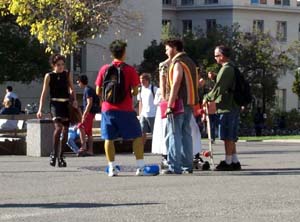 Figure 1. A nomadic group.
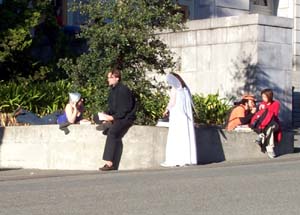 Figure 2. Women finding other things to do. The woman on the left found someone to talk to;
the woman in the center eventually called someone; the woman on the right is reaching into
her bag for a book.
Figure 2. Women finding other things to do. The woman on the left found someone to talk to;
the woman in the center eventually called someone; the woman on the right is reaching into
her bag for a book.
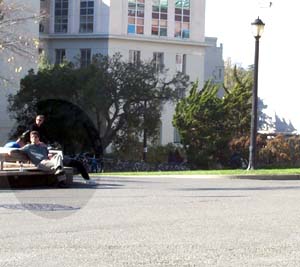 Figure 3. Men watching the plaza.
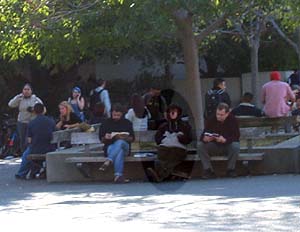 Figure 4. The Watchdog.
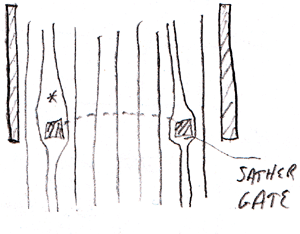 Figure 5. Pedestrians flow around the musician (the *).
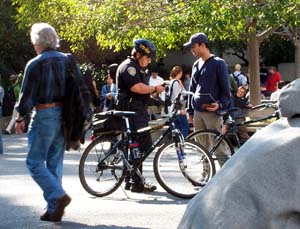 Figure 6. The chase ends.
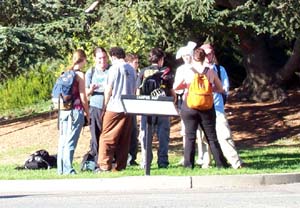 Figure 7. The Enchanted Knoll.