165. Opening to the street: Windows open out to Solano on the south side.
252. Pools of light: Three lights hang over respective tales on the south side of the cafe. They are probably not low enough to "reinforce the social character of the space," however.
244. Canvas Roofs: While they are evident on all sides of the building, they are not adjustable and are clearly just "for show."
249. Ornament: Ornamentation is highly stylized. A small shelf rests against a post in the middle of the cafe to soften the transition from street space to cafe space.
120. Paths and goals: The central post provides a point of reference for people entering the cafe. From there they understand where to go to order.
205. Structure follows social spaces: I am unsure whether the central post is load bearing and of the engineering requirements in general. This pattern seems ambiguous.
179. Alcoves. Though not designed as an alcove, the peninsular space on the southwest of the cafe is a comfortable place for two to four people to segregate themselves.
180. Window place: See the entry for (252). These 5ft windows are usually open and accessible via a bench.
202. Built-in seats: The benches on the south side of the cafe are well padded and plenty wide but do not have backs. Is this so people will not become too comfortable?
192. Windows overlooking life: From any table, patrons can see at least two scenes of street life.
221. Natural doors and windows: The door is standard, but the windows do vary (though only in width). All frames are identical.
222. Low sill: Window sills are only 2 1/2 feet off of the ground.
142. Sequence of sitting spaces: The southwest and northeast corners of the cafe are more enclosed, and therefore more private, spaces.
164. Street windows: Patrons sitting on the bench on the south-side of the cafe can easily see nearby Solano Ave.
236. Windows which open wide: Windows on the south-side of the cafe open wide onto Solano Ave.
196. Corner doors: The main entrance is on a corner of the cafe, as is the entrance to the bathroom.
225. Frames as thickened edges: The main door frame is standard, and the standard door frame swells slightly.
242. Front door bench: The bench near the door was placed by the city. In the two hours I was at the cafe, no one used it.
Patterns not found
88. Street Cafe: Starbucks is not local, has only one room, and even
on a sunny day no one is sitting outside because
of the lack of tables. To remedy, place a few small tables
out front near the entrance and extend the overhang to cover
more of the sidewalk.
150. A place to wait: Starbucks could try to accommodate
people waiting at nearby bus stops with outdoor tables,
but does not.
251. Different chairs: All of the chairs are minimalist, natural wood. The
only variation is in their color. Other Starbucks franchises
use a variety of chairs and sofas.
168. Connection to the Earth: The boundaries of the cafe
are utterly unambiguous. Window sills, outside tables
and extended overhangs could help.
248. Soft tile and brick: The interior floor can is in no way
"soft." Concrete and asphalt surround the exterior.
Perhaps floor could be varied to re-emphasize difference
between public and private spaces.
245. Raised flowers: No flowers whatsoever. Install window sills!
238. Filtered light: Light enters the cafe unimpeded. Outdoor
canvas overhangs could help break up the incoming rays.
224. Low doorway: Doorways are standard height. A lower
doorway might break fire regulations.
223. Deep Reveals: Window frames are lightweight and perpendicular
to the window. Edges could be splayed.
Patterns not applicable
125. Stair seats: No opportunity to apply.
243. Sitting wall: No outdoor area.
95. Building complex: Starbucks is not large enough to necessitate a complex.
241. Seat spots: While there is one bench outside, it was placed by
the city, not Starbucks.
131. The flow through rooms: There is only one room.
98. Circulation realms: This is not a building complex.
193. Half open wall: There is only one room.
237. Solid doors with glass: This pattern applies to interior
doors, of which there are none.

People often want make use of cafes for study sessions, informal meetings or games. They need space to lay out paper projects or other materials.
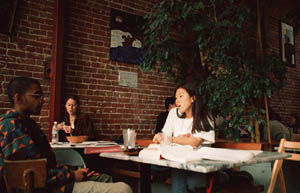
While an individual student can find a place to work nearly anywhere in a cafe, groups need special accomodations. I am a member of a research reading group that meets in a cafe every week to discuss papers and project progress. We have thus far met in two different locations -- Au Coquelet and Berkeley Espresso. In both cafes we were able to find two small tables to push together to form a working space, but it was nonetheless awkward. Starbucks provides a large table towards the back of the cafe, giving small groups a quieter place to spread out papers and work on projects. Also, it is especially helpful to have a bench on at least one side of the table to give people even more space to spread out their materials
But some tables are valuable for game playing as well. At several restaurants and cafes, table-tops overlaid with game grids provide a surface for people to play chess or checkers while waiting for a seat or food. In other places it may be appropriate to simply provide a large table space in a secluded section of the cafe with game nearby, in a pouch on the wall, for example.
Finally, groups might want to work under different levels of light. An overhead light may be useful if laying out papers or sketching ideas, but if people are working independently and communicating only seldomly, as in study groups, smaller more directed lights may be appropriate.
Place small tables with game-board table tops in the waiting area of a cafe or restaurant and larger tables in more secluded areas. Put larger tables near built-in benches and provide adjustable lighting.
Smaller, more mobile tables may be more appropriate in busier, more public areas (142) and may be good places to wait for other guests (150). Built-in seats may well complement larger tables (202).